

ICG-21 Opens in Shenzhen, Spotlighting Bio-Generative Intelligence for Health and New Frontiers in Genomics
SHENZHEN, China, Sept. 08, 2026 (GLOBE NEWSWIRE) -- The 21st Annual Meeting of the International Conference on Genomics (ICG-21) was held at the BGI Center in Shenzhen from September 7 to 8. Under the theme “Bio-Generative Intelligence for Health”, the conference brought together leading experts and scholars from universities, research institutes, hospitals, and industry worldwide to explore how cutting-edge science and technology can advance human health and well-being.
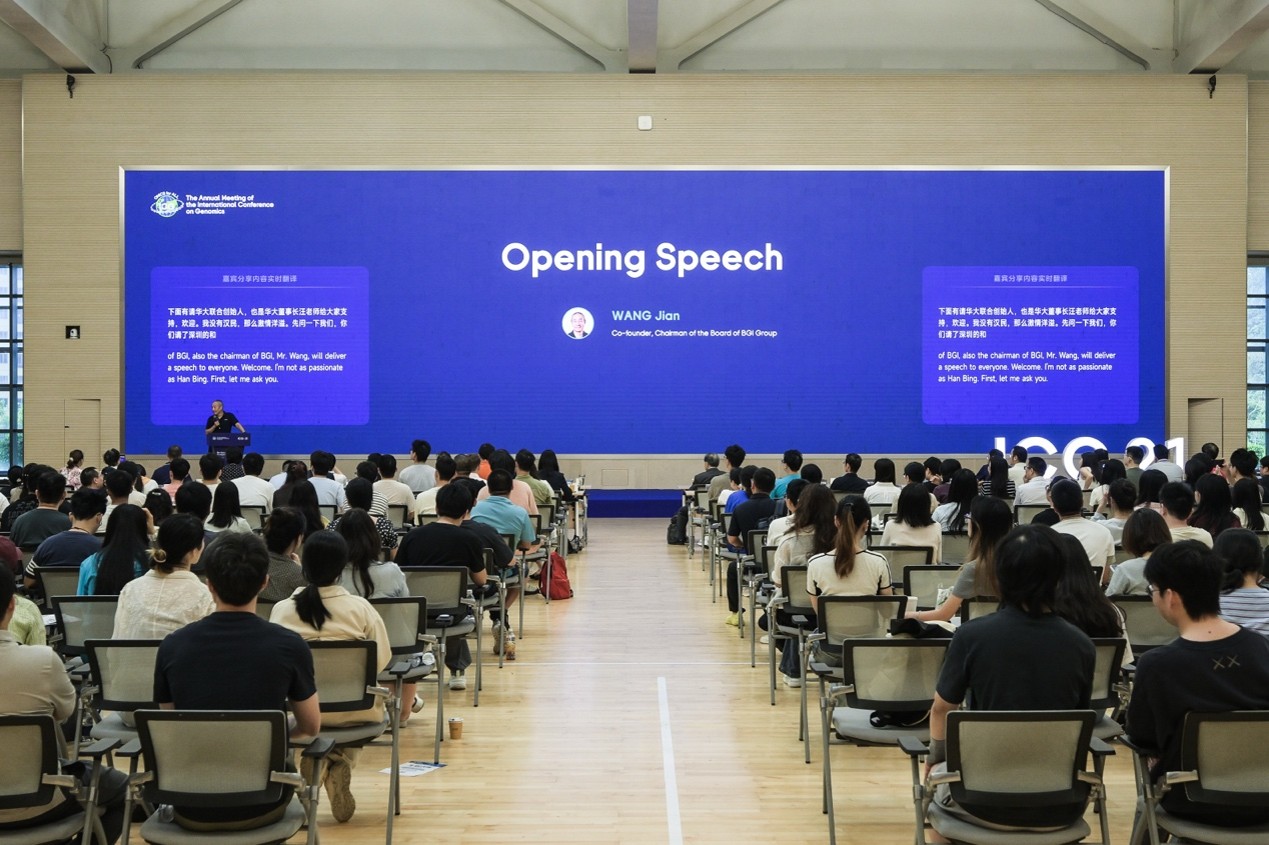
ICG-21 conference venue.
Since its inaugural meeting in 2006, ICG has carried forward the spirit of the Human Genome Project - “Owned by All, Done by All, and Shared by All.” Over the past two decades, the conference has witnessed the evolution of genomics from decoding the sequence of life, to multi-omics exploration of biological complexity, and now to a new era in which artificial intelligence is reshaping life science research. ICG has grown into an influential international platform for academic exchange and collaboration in genomics and life sciences.
At the opening ceremony, Professor Huanming Yang, Academician of the Chinese Academy of Sciences, Co-founder of BGI Group and Chairman of BGI-Research, delivered remarks in memory of Professor James Watson, co-discoverer of the DNA double helix structure. As a key initiator of the Human Genome Project, Professor Watson played an instrumental role in advancing this landmark scientific endeavor and provided crucial support for China’s participation in the project. Professor Yang shared insights from the international collaboration that drove the Human Genome Project forward, and called for continued commitment to the scientific principles of openness and sharing, the cultivation of the next generation of researchers, and the use of cutting-edge omics innovation to advance human health.
Professor Jian Wang, Co-founder and Chairman of the Board of BGI Group, also delivered remarks at the opening ceremony. He reviewed BGI’s journey in genomics, tracing its origins to 1999, when BGI participated in the Human Genome Project, and highlighted its long-term dedication to omics research. He noted that BGI has benefited from Shenzhen’s open, inclusive, and innovation-driven environment, producing a series of internationally influential scientific achievements and continuously advancing the application of omics technologies in real-world scenarios to support public health. Professor Wang encouraged the team to remain committed to its original scientific aspirations and strive to build a world-class force in life science research.
Keynote Sessions: Global Collaboration, AI Medicine, Brain Technology, and Regenerative Innovation
ICG-21 invited distinguished scholars and thought leaders from China and abroad to deliver keynote speeches covering global public health collaboration, intelligent medical innovation, brain-computer interface development, regenerative medicine, and other emerging fields.
Professor Fred Dubee, Co-chair of the ICG International Advisory Board and Former Senior Advisor to the United Nations Global Compact, presented the latest progress of the African Soil Strength Program (ASSP), a China–Africa soil innovation collaboration project. Officially launched in Shenzhen in 2023, the program takes The Gambia as its pilot project and aims to expand soil restoration solutions across sub-Saharan Africa. To date, the project has analyzed 500 soil samples, restored more than 200 hectares of degraded land, and directly benefited over 2,000 farmers. Professor Dubee also called for broader international collaboration to support sustainable agricultural development in Africa.
Professor Ya Zhang, Distinguished Professor, Vice Dean of the School of Artificial Intelligence, and Executive Vice Dean of the Medical Artificial Intelligence Research Institute at Shanghai Jiao Tong University, delivered a keynote speech addressing the long-standing challenges in rare disease diagnosis and treatment, including limited case availability, diagnostic difficulty, and the complexity of interpreting genetic variants. She introduced DeepRare and DeepRare V2, evidence-based reasoning agent systems for rare diseases developed by her team, and demonstrated how AI can improve the efficiency of complex diagnosis and genetic variant interpretation through active information retrieval, multi-step reasoning, and traceable evidence chains. Professor Zhang noted that the value of AI in life sciences is evolving from “assisting diagnosis” to “proposing and validating hypotheses.” Looking ahead, she said that by forming a closed loop among AI, clinical practice, and experimental research, AI is expected to further advance rare disease research from diagnosis and treatment toward mechanistic discovery.
Dr. Chengyu Li, Senior Researcher, Chief Scientist for brain computer interfaces (BCI) and Director of the Department of Brain Technology and Engineering at Lingang Laboratory, shared insights into the application directions of BCI technologies. To explore the composition and functional mechanisms of the brain, Dr. Li’s team has applied multi-omics technologies to analyze brain cells in model animals such as macaques and marmosets, successfully producing the world’s first single-cell spatial distribution atlas of the primate cerebral cortex. The team has also independently developed a range of innovative tools, including invasive BCI chips, electrodes, algorithms, packaging technologies, and integrated systems. Focusing on the development of cutting-edge tools to decode brain structure and operational logic, Dr. Li is committed to advancing the continued development of brain-computer interface technologies.
Professor Jufang Zhang, Chief Physician in the Department of Plastic Surgery at Zhejiang Provincial People’s Hospital, delivered a keynote titled “Application of Follicular Unit Grafts in Wounds and Scars.” As a renowned specialist in hair medicine, Professor Zhang discussed the clinical potential of follicular transplantation and hair follicle stem cell-based therapeutic approaches in chronic wound repair. She highlighted that follicular transplantation could suppress inflammation, remodel the wound microenvironment, and promote tissue repair. As an effective and minimally invasive intervention, the approach may provide primary healthcare institutions with a novel treatment option and expand the application of hair medicine in regenerative repair.
Five Parallel Tracks: Beauty, Health, Longevity, Wisdom, and Well-being
In addition to the keynote sessions, ICG-21 featured five parallel academic tracks - Beauty, Health, Longevity, Wisdom, and Well-being - bringing together experts in clinical medicine, pharmacy, computer science, biology, neuroscience, psychology, business, and public health to explore life and health from scientific, clinical, technological, and humanistic perspectives.
The Beauty track looked at skin health and beauty innovation from both scientific and clinical angles. Speakers from Xiangya Hospital of Central South University, Sun Yat-sen University, The Chinese University of Hong Kong, Unilever R&D Center, and Zhejiang Provincial People’s Hospital shared work on skin spatial mapping, skin organoids, tissue-engineered skin, AI-assisted drug discovery, beauty and personal care innovation, and the diagnosis and treatment of medical aesthetic conditions.
The Health track focused on how genomics can better support public health and personalized medicine. Speakers from Central South University and BGI Group introduced China’s pharmacogenomics landscape based on whole-genome sequencing, as well as the Human Genome Project II, a goal of sequencing at least 1% of the world’s population and bringing genomics into healthcare systems for prevention, early detection, and public health management.
The Longevity track brought together different views on aging and how it might be delayed or better managed. Speakers from R42 Group, Westlake University, State Key Laboratory of Genome and Multi-omics Technologies at BGI-Research, and Fujian Medical University covered cancer and aging vaccines, cellular rejuvenation, primate brain aging, multi-omics studies of long-lived individuals, and links between skeletal muscle and cardiovascular aging.
The Wisdom track connected AI with biology, neuroscience, and health technologies. Speakers from Westlake University, the Center for Excellence in Brain Science and Intelligence Technology at Chinese Academy of Sciences, BGI CELL, and Southern University of Science and Technology discussed brain-inspired intelligence, multi-omics data integration, precision gene editing tools, and foundation models for brain-computer interfaces.
The Well-being track moved beyond disease and treatment to broader questions of how people live and thrive. Speakers from Sun Yat-sen University, Shenzhen University, and Tsinghua University discussed workplace well-being, adolescent mental health, and how the built and natural environment can shape longevity, cognition, mortality risk, and quality of life.
Featured Events: Public Science and Education
Beyond the main academic conference, ICG-21 also featured a series of special sessions and public engagement activities. On September 7, the Science Popularization Carnival brought together leading science communicators, including Dr. Ye Yin, CEO of BGI Group, to translate cutting-edge life science research into accessible public knowledge for young people and general audiences. On the same day, an Education Forum convened education experts, researchers, and frontline educators to discuss life science communication, interdisciplinary education, and innovative approaches to cultivating future scientific talent.
Over two days, ICG-21 demonstrated the depth and breadth of “Bio-Generative Intelligence for Health” through academic exchange, public science engagement, and cross-disciplinary dialogue. In the future, ICG will continue to uphold its founding spirit of “Owned by All, Done by All, and Shared by All,” building an open and inclusive global platform for life science collaboration. By promoting the translation of genomics, artificial intelligence, multi-omics, and related frontier technologies, ICG aims to contribute scientific strength to the health and well-being of all humanity.
Company: ICG Organizing Committee
Contact Person: Ricado Lee
Email: media@genomics.cn
Website: https://icg.bio/
Telephone: +86-755-36307888
City: Shenzhen
A photo accompanying this announcement is available at https://www.globenewswire.com/NewsRoom/AttachmentNg/6877ae7a-7fd4-4d57-85ed-1f3cb41da2e4

ICG-21 conference venue.
ICG-21 conference venue.
Legal Disclaimer:
EIN Presswire provides this news content "as is" without warranty of any kind. We do not accept any responsibility or liability for the accuracy, content, images, videos, licenses, completeness, legality, or reliability of the information contained in this article. If you have any complaints or copyright issues related to this article, kindly contact the author above.
